Unknown. 1924. [Clifford Berryman profile]. Editor and Publisher 57 (14; August 30): 10. Online at https://archive.org/details/sim_editor-publisher_1924-08-30_57_14/page/10/mode/2up
Showing posts with label Clifford Berryman. Show all posts
Sunday, November 09, 2025
Wednesday, May 01, 2024
An "unknown" Clifford Berryman self-portrait
This surfaced recently in the National Geographic archives before being sent out for deep storage. Berryman apparently drew it for the editor Gilbert H. Grovesnor as an RSVP to a luncheon invitation because it's on a piece of his stationary.
Berryman is hurrying to see artist / explorer Alexander Iacolevff who had worked on a story about Vietnam for them in 1935. Presumably he was back in the States by the beginning of the year, because Berryman's dated his cartoon to March 15, 1935 for a lunch on the 18th. Here's one of the artworks Iacolevff did at the time. Here's a painting that National Geographic used to own before they auctioned off a good bit of their patrimony in 2012, including more by him, and paintings (plural for both) by NC Wyeth, and dinosaur artist Charles Knight, and a lot of famous photographs. Browse the whole list here. They made $3,776,587 before selling themselves to Fox a few years later.
Thursday, August 24, 2023
Clifford Berryman collection in the DC Public Library
![]() |
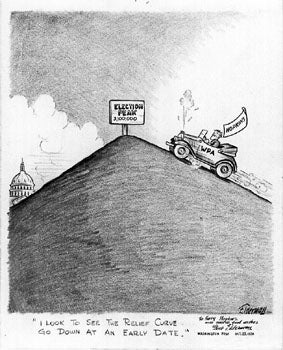
Will it come to this? |
- Clifford Berryman Cartoon Collection (132)
- https://digdc.dclibrary.org/islandora/object/dcplislandora%3Aberryman
![]() |
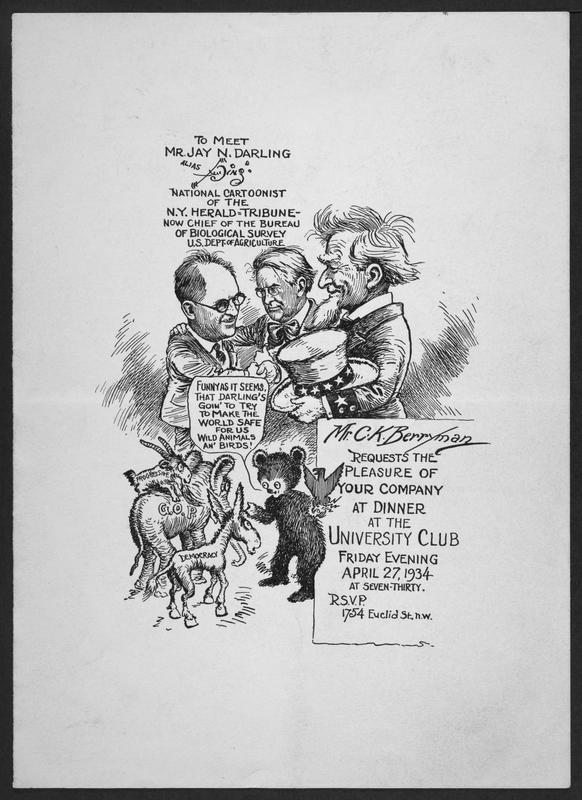
Invitation to dinner for Jay N. Darling |
The cartoons address D.C. community issues, congressional appropriation and District finances, holidays and events, national politics, District political representation, weather and nature, and World Wars I and II. Many of these works include Berryman’s most famous creation, the “Berryman Bear,” a small, fuzzy bear cub often paired with President Theodore Roosevelt that was the inspiration for the toy teddy bear. The collection also contains a handful of miscellaneous Berryman drawings and printed cards and caricatures of prominent Washingtonians.
The entire D.C. Public Library Berryman cartoon collection has been digitized and is arranged in alphabetical order by title. Additional Berryman cartoons can be found in the collections of the National Archives and Records Administration and the Library of Congress, among other institutions.
Satires (Visual works)
![]() |
Conferences and meetings convening in the city |
Thursday, January 01, 2015
A couple or three old bits for the New Year
The Washington Post did something, probably not in the actual paper, on editorial cartoons in 2003.
In 1939, Charles Howard collected original cartoons from Washington newspaper cartoonists Clifford Berryman, H.M. Talbert and Gene Elderman. I have no idea why the Art Institute of Chicago has a 4-page finding aid to them on its website. Nor do I know who Talbert is.
Harry Hopkins and the NewDeal: As Seen by the Cartoonists was an exhibit at Georgetown University in 1998. It also included Berryman, Elderman and Bill Talburt (note spelling)
In 1939, Charles Howard collected original cartoons from Washington newspaper cartoonists Clifford Berryman, H.M. Talbert and Gene Elderman. I have no idea why the Art Institute of Chicago has a 4-page finding aid to them on its website. Nor do I know who Talbert is.
![]() |
| Elderman, courtesy of GU |
Tuesday, October 21, 2014
Clifford Berryman Cartoon Collection at the DC Public Library (UPDATED)
![]() |
|
The Clifford Berryman Cartoon Collection at the DC Public Library has been digitized. Their website claims 132 images are available, including the above 1908 cartoon about the President not attending to his duties.
The collection description reads:
About this collection
The Clifford Berryman Cartoon Collection contains 108 political cartoons of the Pulitzer Prize winning D.C. editorial cartoonist donated to the library by the artist's daughter. Most of the cartoons are original drawings created by Berryman for publication in the Washington Evening Star from approximately 1900 to 1948.
The cartoons address D.C. community issues, congressional appropriation and District finances, holidays and events, national politics, District political representation, weather and nature, and World Wars I and II. Many of these works include Berryman's most famous creation, the "Berryman Bear," a small, fuzzy bear cub often paired with President Theodore Roosevelt that was the inspiration for the toy teddy bear. The collection also contains a handful of miscellaneous Berryman drawings, cards, and caricatures.
The entire Berryman collection has been digitized and is available here.
Most Berryman images are in the public domain, but the rights status of each item is noted.
11/12/2019: Updated with new links.
The cartoons address D.C. community issues, congressional appropriation and District finances, holidays and events, national politics, District political representation, weather and nature, and World Wars I and II. Many of these works include Berryman's most famous creation, the "Berryman Bear," a small, fuzzy bear cub often paired with President Theodore Roosevelt that was the inspiration for the toy teddy bear. The collection also contains a handful of miscellaneous Berryman drawings, cards, and caricatures.
The entire Berryman collection has been digitized and is available here.
Most Berryman images are in the public domain, but the rights status of each item is noted.
11/12/2019: Updated with new links.
Saturday, June 14, 2014
A forgotten Clifford Berrryman poster
I'm reading Nancy K. Bristow's book American Pandemic: The Lost Worlds of the 1918 Influenza Epidemic, and she mentions a US Public Health Service poster drawn by a "well-known Washington cartoonist.
Wednesday, December 11, 2013
More photos of Geppi's Entertainment Museum
Friday, December 07, 2012
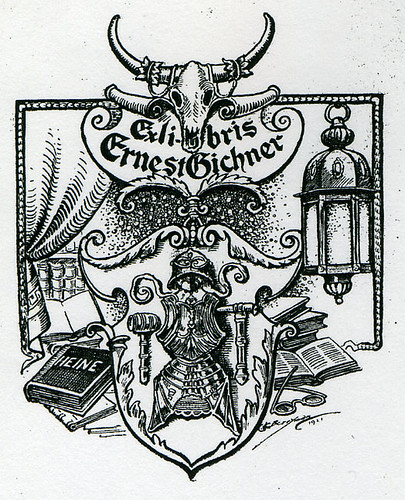
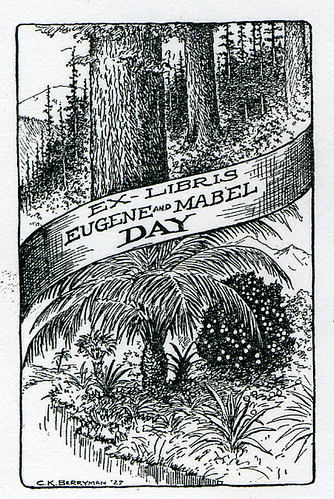
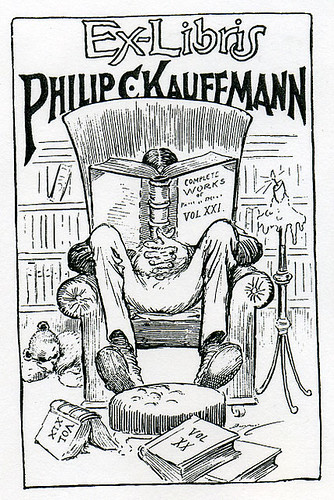
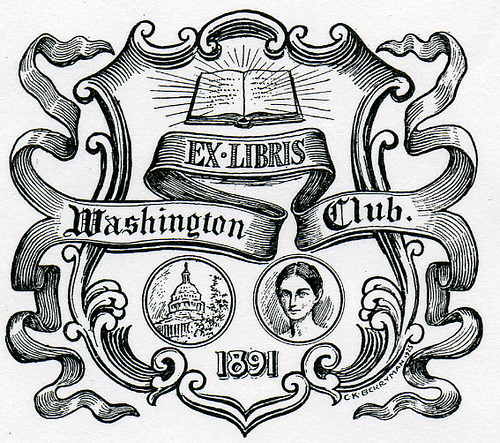
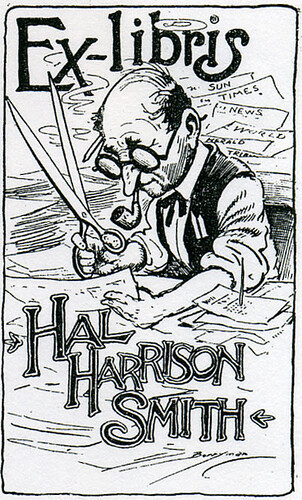
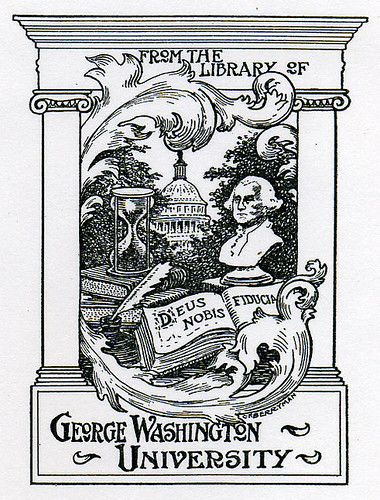
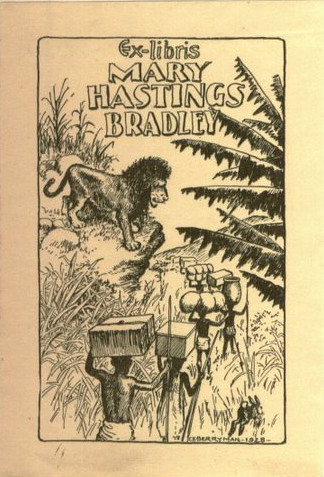
Of Bear Cubs and Bookplates
| By Michael Rhode (originally appeared on Hogan's Alley's website in 2006) |
Political cartoonist Clifford Berryman is largely forgotten today. When he is remembered, it is for his 1902 creation of the Teddy bear. President Roosevelt refused to shoot a captured bear cub while hunting, and Berryman drew his most famous cartoon, "Drawing the Line in Mississippi," showing Roosevelt's refusal. His cute cub drawing was turned into a toy Teddy bear and has comforted millions of children.
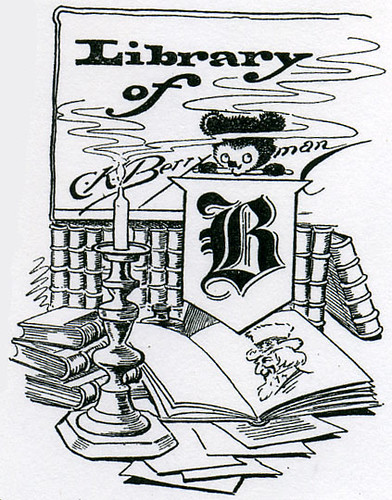
But in his day, Berryman was considered the dean of cartoonists and, according to Wendy Kail in an article on him in the International Journal of Cartoon Art, drew over 15,000 political cartoons. Like many other cartoonists, he worked in several fields including book illustration. Berryman may be the only cartoonist to have drawn bookplates--the small slip of paper glued in the front cover of a book to proclaim ownership.
Berryman's interest in doing this work may have been influenced by his daughter, Florence, who produced a slim book, Early American Bookplates (1926). The book, reprinting an article she did for the yearbook of the American Society of Bookplate Collectors and Designers, included illustrations of American Revolution figures by her father.
Due to the generosity of a private collector, I'm pleased to be able to present these rare examples of a cartoonist's art.
Tuesday, February 09, 2010
So who was editorial cartoonist John M Baer anyway?

For our 3rd post on editorial cartoonist John M Baer, we finally have some real information, courtesy of Curt Hanson, Department Head, Elwyn B. Robinson Department of Special Collections, Chester Fritz Library, University of North Dakota. Thanks to Curt for providing copies of articles about Baer, and also for pointing out their digitized collection of Stuart McDonald editorial cartoons.

The first article by Charles P. Stewart of the Central Press Association appears to be from 1921. Baer had been elected to congress from North Dakota in 1917 as an advocate for labor and farmers. In this article Baer blamed his re-election loss on his cartooning, rather than the fact that he was on the left (blue) in a right (red) district. The article said, "The fact is, Baer's cartoons had not rated as of national importance while their circulation was confined to North Dakota. As a congressman's handiwork, however, they quickly began making their appearance in all corners of the republic, causing widespread trouble for conservatism. In consequence, the campaign of 1920 saw an invasion of the Fargo district by outside spellbinders with practically unlimited resources. Since then Cartoonist Baer has been an ex-congressman."
Personally, I doubt that his cartooning was the cause of his election loss, but who can say 90 years later? He apparently was represented at some point by King Features Syndicate, who released the following:
World-Famous Artist Crashed Congress With A Lead Pencil
Washington, D.C. - Let it be understood that John M. Baer knows his politics from left to right, up and down and diagonally. For years he has been the champion of the farmer and the worker, fighting for them, not with glib, silver-tongued oratory but with a facile cartooning crayon that clarifies and mocks at most intricate bits of Machiavellian chicanery that back-room politicians ever foisted upon a suffering country.
Baer's political cartoons are known wherever a newspaper is read and he has he distinction of being the only man who ever crayoned himself into Congress, his Farm-Labor and Graft drawings having brought him such prominence that he was elected to fill the term of Congressman Helgessen of North Dakota, on the latter's death in 1917. At the expiration of that term, he was re-elected.
It was in 1912 that he came into real prominence by cartooning an expose of how the farmers were being "gypped" 90 cents per bushel on their wheat.
Since then he has never ceased in his fight on graft and shady political dealings and his work has appeared in most of our national periodicals and newspapers. His friends, among them workers of every calling, number millions and he is adding to the list daily. Baer's home is in Washington, D.C., where he keeps a watchful eye on the solons that make the wheels go round. One wonders if he is ever amused at the tales of huge campaign funds ad he remembers how he crashed Congress with a pencil.
"John M. Baer, once N.D. Congressman, still active at 83," a 1969 article by Jack Hagerty for the Grand Forks Herald provided far more information on Baer's life and career. Baer was born Mach 29, 1886 in Black Creek, Wisconsin, went to Lawrence University where he edited the newspaper and the yearbook before graduating in 1909, and then married a woman from North Dakota and moved to work on her father's farm. In 1913 he was appointed a postmaster, but soon was making more money from cartoons so in 1916 he moved to Fargo, North Dakota, to work for the Courier-News.
After losing re-election, Baer worked for Labor, a railroad union newspaper. In 1969, he was still working for them in an AFL-CIO building on Lafayette Square, but also cartooning at his home in Chevy Chase, MD.

Hagerty's article says this "Appropriation Pie" cartoon was printed over 100 million times, in 18 languages, and was credited with bringing about the Naval Disarmament Conference of 1921. Unfortunately, it's still true - past wars are shown as taking up 68% of the budget, defense with 25%, education at 1% and 6% left to labor, farmer and public.

Hagerty's article says that General Billy Mitchell distributed 20 million copies of this cartoon in 1925 and it was used in his court martial over aggressively pursuing an air force.

Baer's 1931 cartoon that was credited with coining the phrase "The New Deal." The worker, honest business and the farmer are saying "We demand a new deal" at a crooked card game with speculators, big business and cooked politicians.

A sidebar to Hagerty's article says that "For 58 years, he has used bears on his Christmas cards, but was turned down when he offered another cartoonist $1,000 for the right to use a bear symbol as an identifying mark in his cartoons." The other cartoonist is undoubtedly Clifford Berryman, also of Washington, who created the Teddy bear and drew him in many cartoons.
Friday, December 11, 2009
How to become a cartoonist in Washington, circa 1923
Mike Lynch has scans up of "How to become a cartoonist" Washington School of cartooning, 1923. The teacher is Will Chandlee, whose work I don't know, and there's a testimonial by Clifford Berryman.
Sunday, August 30, 2009
Cartoons for the Classroom - Berryman's Teddy Bear
The August 30 2009 Cartoons for the Classroom features Washington Star cartoonist Clifford Berryman and the teddy bear he created.
Sunday, August 02, 2009
AAEC's Cartoons for the Classroom features Berryman's lame duck
The AAEC's Cartoons for the Classroom feature, which links editorial cartoons to the news for students, uses Clifford Berryman's lame duck cartoon from the National Archives this week.
Wednesday, May 13, 2009
Did you know? Krazy Kat in Georgetown

Did you know that Georgetown University's Lauinger Library holds two original Krazy Kat Sunday pages by George Herriman? No, I didn't either. David Hagen showed them to me last week. They're in the Archives, of course, as is at least one large collection of political cartoons, from a politician who collected images of himself, I think. There's definitely a Clifford Berryman in there, and I saw a Gib Crockett on the University Archivist's wall. I'm afraid I can't figure out their website well enough to track down the collection though, but you could contact them to ask.
Wednesday, September 10, 2008
1926 article on Clifford Berryman
Allan Holtz has reprinted a 1926 article on Washington Star cartoonist Clifford Berryman - "Cartoons Growing In Popularity Berryman Says; Washington Star Veteran Cites Government Officials and Congressmen Who Declare Powerful Cartoons Influence Political Contests-Backs Them Against Humorous Writing," By Mary M. Crenshaw (E&P 5/29/26).
Saturday, August 16, 2008
August 16: Berryman exhibit closes
Tomorrow's the last day of the Clifford Berryman political cartoon exhibit at the National Archives on 9th and Pennsylvania Ave, NW. It's a good show.
Friday, June 27, 2008
Clifford Berryman exhibit press preview remarks
Here's another audio file. I found this again as I wrote my review for the International Journal of Comic Art, so I figured I'd make it available. It features the Archivist of the United States Howard Weinstein and the curators of the exhibit when the exhibit was previewed for the press.
Press preview remarks to the Clifford Berryman exhibit, "Running for Office: Candidates, Campaigns, and the Cartoons of Clifford Berryman" at the National Archives, Washington, DC from February 8 - August 17th, 2008.
Friday, June 06, 2008
Post reviews trifecta of political cartoonists exhibits
The Berryman, Herblock and Oliphant shows got noticed in today's Weekend section. See "Political Lines, Sharply Drawn," By Michael O'Sullivan, Washington Post Staff Writer, Friday, June 6, 2008; Page WE23 who for some reason seems to feel that Oliphant is too hard on politicians. "Is that possible?" I must ask.
Actually, it's a shame this story wasn't longer as Sullivan could have been onto something, but had only 2 paragraphs per exhibit to make his point. Personally, I don't agree with him that political cartoonists are getting harder on their subjects. There's a lot of softballs out there, and the fact that Oliphant is throwing them may very well be the reason that he doesn't have a base newspaper. And Berryman's contemporaries could be as biting as any cartoonists - Berryman just chose not to be.
Here's the basic information lifted from the Post:
A Trio of Cartoon Exhibitions
Friday, June 6, 2008; Page WE23
Running for Office: Candidates, Campaigns and the Cartoons of Clifford Berryman Through Aug. 17 at the National Archives, Constitution Avenue between Seventh and Ninth streets NW (Metro: Archives-Navy Memorial). 866-272-6272. http://www.archives.gov. Open daily 10 to 7. Free.
Herblock's Presidents: "Puncturing Pomposity" Through Nov. 30 at the National Portrait Gallery, Eighth and F streets NW (Metro: Gallery Place-Chinatown). 202-633-1000 (TDD: 202-633-5285). http://www.npg.si.edu. Open daily 11:30 to 7. Free.
Leadership: Oliphant Cartoons and Sculpture From the Bush Years Through July 15 at the Stanford in Washington Art Gallery, 2655 Connecticut Ave. NW (Metro: Woodley Park-Zoo/Adams Morgan). 202-332-6235. Open Monday-Friday 9 to 7; Saturday-Sunday noon to 6. Free.
Actually, it's a shame this story wasn't longer as Sullivan could have been onto something, but had only 2 paragraphs per exhibit to make his point. Personally, I don't agree with him that political cartoonists are getting harder on their subjects. There's a lot of softballs out there, and the fact that Oliphant is throwing them may very well be the reason that he doesn't have a base newspaper. And Berryman's contemporaries could be as biting as any cartoonists - Berryman just chose not to be.
Here's the basic information lifted from the Post:
A Trio of Cartoon Exhibitions
Friday, June 6, 2008; Page WE23
Running for Office: Candidates, Campaigns and the Cartoons of Clifford Berryman Through Aug. 17 at the National Archives, Constitution Avenue between Seventh and Ninth streets NW (Metro: Archives-Navy Memorial). 866-272-6272. http://www.archives.gov. Open daily 10 to 7. Free.
Herblock's Presidents: "Puncturing Pomposity" Through Nov. 30 at the National Portrait Gallery, Eighth and F streets NW (Metro: Gallery Place-Chinatown). 202-633-1000 (TDD: 202-633-5285). http://www.npg.si.edu. Open daily 11:30 to 7. Free.
Leadership: Oliphant Cartoons and Sculpture From the Bush Years Through July 15 at the Stanford in Washington Art Gallery, 2655 Connecticut Ave. NW (Metro: Woodley Park-Zoo/Adams Morgan). 202-332-6235. Open Monday-Friday 9 to 7; Saturday-Sunday noon to 6. Free.
Monday, February 04, 2008
More Berryman exhibit coverage
The Clifford Berryman exhibit that is opening later this week at the National Archives continues to generate press. You can see my post about the exhibit here.
And the previously mentioned article in the Washington Post:
"Caricaturing Campaigns: Exhibit of Cartoonist's Sketches Links Politics Then and Now," by Michael E. Ruane, Washington Post Sunday, February 3, 2008; C03.
and this one that snuck by me until today, "National Archives unveils political cartoons," By Johanna Neuman, Los Angeles Times Staff Writer, January 31, 2008.
Jennifer Rios of the Scripps Howard Foundation Wire wrote one too "After 60 years, political cartoons in exhibit remain relevant," - you can register for free to view it, or see it here.
And the previously mentioned article in the Washington Post:
"Caricaturing Campaigns: Exhibit of Cartoonist's Sketches Links Politics Then and Now," by Michael E. Ruane, Washington Post Sunday, February 3, 2008; C03.
and this one that snuck by me until today, "National Archives unveils political cartoons," By Johanna Neuman, Los Angeles Times Staff Writer, January 31, 2008.
Jennifer Rios of the Scripps Howard Foundation Wire wrote one too "After 60 years, political cartoons in exhibit remain relevant," - you can register for free to view it, or see it here.
Sunday, February 03, 2008
Good Berryman article in Post
This article is good and has a bit more history on Berryman that I put in my earlier blog post. See "Caricaturing Campaigns: Exhibit of Cartoonist's Sketches Links Politics Then and Now," by Michael E. Ruane, Washington Post Sunday, February 3, 2008; C03.
Thursday, January 31, 2008
Berryman exhibit at National Archives preview UPDATED
Thanks to my colleague Miriam (we bonded over stories of St. Elizabeth Hospital records), I got to see the new National Archives exhibit on Clifford Berryman today. Running for Office: Candidates, Campaigns, and the Cartoons of Clifford Berryman is open at the downtown branch from February 8 - August 17th. A formal review will appear in the fall issue of the International Journal of Comic Art, but here's some notes.

The exhibit was curated by Jessie Kratz and Martha Grove. They looked through the 2,400 pieces of artwork that the Senate was given after the cartoons were found in garbage bags in Berryman's daughter's house in the early 1990s. The curators looked through all of the drawings for cartoons that related to the campaign process. They divided the exhibit into sections: Throwing Your Hat in the Ring!, Narrowing the Field, Running for Congress, The Campaign, The Voter, Candidate William Jennings Bryan, The Homestretch and The Results Are In! I'd guesstimate that about 50 cartoon are displayed including a self-portrait with teddy bear. Berryman's lasting claim to fame, beyond being a professional cartoonist for 53 years, is drawing a bear cub that Teddy Roosevelt refused to shoot. The teddy bear became an icon of his drawings.
Berryman was a consummate professional. There's barely any visible underlying pencil or scraping out of unwanted lines. His characters are clearly recognizable, although more as portraits than caricatures as Warren Bernard pointed out. However, as Richard Baker, a Senate Historian noted in his introduction, Berryman "...combined a fine skill in caricaturing Senators with a gentle humor..." The gentle humor means that these cartoons are very gentle indeed, especially when compared to Nast and Oliphant at the opposing ends of Berryman's career.
Ahh, the lame duck!
Still, I like his work. His drawing of Roosevelt as Shakespeare's Hamlet is fantastic. Henry Ford was satirized as wearing a bathing suit, but refusing to dive into the 'presidential pool'. His elephant and donkeys symbols are excellent pen and ink works. His line is clear and easy to understand, even with his use of a massive amount of crosshatching.
The curators made a good selection of cartoons - most are still easily understandable. A reproduction of a front page of Washington's Evening Star shows how these cartoons would have appeared originally - far smaller, but on the front page of the paper. Berryman was considered the dean of Washington cartoonists, and a visit to this exhibit can show you why.
The exhibit has a small brochure, and a catalogue which appears very well done. Full of color reproductions, it's for sale at the Archives; gift shop. Remember that there's a program with Oliphant, Stephen Hess, Telnaes, Matt Davies and Clay Bennet on the evening of February 7th.
For a week from February 1, you can download the prefatory comments by the Archivist of the US, a historian of the Senate, the curator and Miriam here. I made the recording to help writing a review.

The exhibit was curated by Jessie Kratz and Martha Grove. They looked through the 2,400 pieces of artwork that the Senate was given after the cartoons were found in garbage bags in Berryman's daughter's house in the early 1990s. The curators looked through all of the drawings for cartoons that related to the campaign process. They divided the exhibit into sections: Throwing Your Hat in the Ring!, Narrowing the Field, Running for Congress, The Campaign, The Voter, Candidate William Jennings Bryan, The Homestretch and The Results Are In! I'd guesstimate that about 50 cartoon are displayed including a self-portrait with teddy bear. Berryman's lasting claim to fame, beyond being a professional cartoonist for 53 years, is drawing a bear cub that Teddy Roosevelt refused to shoot. The teddy bear became an icon of his drawings.
Berryman was a consummate professional. There's barely any visible underlying pencil or scraping out of unwanted lines. His characters are clearly recognizable, although more as portraits than caricatures as Warren Bernard pointed out. However, as Richard Baker, a Senate Historian noted in his introduction, Berryman "...combined a fine skill in caricaturing Senators with a gentle humor..." The gentle humor means that these cartoons are very gentle indeed, especially when compared to Nast and Oliphant at the opposing ends of Berryman's career.
Ahh, the lame duck!Still, I like his work. His drawing of Roosevelt as Shakespeare's Hamlet is fantastic. Henry Ford was satirized as wearing a bathing suit, but refusing to dive into the 'presidential pool'. His elephant and donkeys symbols are excellent pen and ink works. His line is clear and easy to understand, even with his use of a massive amount of crosshatching.
The curators made a good selection of cartoons - most are still easily understandable. A reproduction of a front page of Washington's Evening Star shows how these cartoons would have appeared originally - far smaller, but on the front page of the paper. Berryman was considered the dean of Washington cartoonists, and a visit to this exhibit can show you why.
The exhibit has a small brochure, and a catalogue which appears very well done. Full of color reproductions, it's for sale at the Archives; gift shop. Remember that there's a program with Oliphant, Stephen Hess, Telnaes, Matt Davies and Clay Bennet on the evening of February 7th.
For a week from February 1, you can download the prefatory comments by the Archivist of the US, a historian of the Senate, the curator and Miriam here. I made the recording to help writing a review.
Subscribe to:
Comments (Atom)
.jpg)

.jpg)