Sunday, June 21, 2026
Zach Weinersmith at Scrawl Books (updated with audio and photos)
Tuesday, October 28, 2025
Chatting with comics writer Barbara Perez Marquez
![]() |
| Baltimore Comic-Con |
by Mike Rhode
Barbara Perez Marquez was at both Small Press Expo and Baltimore Comic-Con this fall, so I asked if she'd answer our usual questions, altered for her Baltimore base. Additionally, Barbara tweaked a few of the questions, which I'm always glad to see.
I'm a writer, primarily of middle grade and young adult stories. Genre-wise I'm pretty expansive, from contemporary to fantasy stories and anything in between.
How do you do it? I know you're a writer - feel free to explore how you get an idea and then write a script.
Usually I start with something closer to a concept than a full-on idea for my stories. From there I'll expand it further (either starting an outline proper or even just listing out some story beats), at which point I get a better idea if I have a full story in my hands or if I need to start exploring further to find it.
If during that part of the process there's already an artist I'll be collaborating with (this isn't always the case or in others sometimes they are ALREADY involved from idea inception), then about this stage is when I ask them to jump in so we can make the foundation of the story something we can all be excited about. At this stage I'll also see if there's any particulars they'd like to see in terms of the style of the script. While across the board I use the same styling for my scripts, (if able) I try to meet the artist's needs in terms of ways in which the script can work with their own process. There's some variability from project to project, but after the above is mostly sorted, that's when I properly start writing. Nothing too exciting in terms of tools of the trade for my scripts, I actually dislike fancy word processors because I find convoluted formatting and file type transfers to be a headache, so I use OpenOffice with the least amount of bells and whistles I can manage.
When and where did you start working in comics?
I grew up in the Dominican Republic, which has a very different comics culture than we see in the USA (plus I was a '90s kid, so add that on to the difficulty of being outside of the American comics market). Most of my early comics reading were European comics and as far as DC and Marvel went, it was mostly the animated media for them and the Pepsi character cards.
It wasn't until college (in New York) when I properly dove into comics by way of indie comics and then onto more traditional cape comics. After that it's been mostly history, I wrote my first comic script around 2014 and it honestly got me hooked, I'd already been producing prose and poetry pieces by then, but comic scripts quickly became a staple in my portfolio too.
![]() |
| SPX |
What is your training and/or education in cartooning?
I'd known I wanted to be a writer pretty early on in life and I moved to New York to pursue a degree in Creative Writing. As I mentioned, I'd grown up around comics enough, but it wasn't until 2014 that I really dove into writing them. Around that time I was working on an MFA in Creative Writing and I actually updated my coursework to add comics scripting to my workload (particularly around graphic novels). At the school I went to, Manhattanville University, Paul Levitz was a professor at the time. Similar to comics, I'd known about him from friends who'd taken his classes but didn't quite understand the magnitude of it until that comics writing spark fully formed for me.
By the time I realized it, none of the coursework he was offering lined up with my schedule. I wrote him this sort of shot in the dark email and explained my interest in writing comics and asked if he had any guidance. Thankfully, he replied back with a list of titles, which I immediately checked out from the library while I gathered enough cash to buy second hand copies to own. Those books basically created a "how to write comics" course of my own making. Shortly after that, I started applying to comic anthologies and involving myself in the comics community via social media.
Years later, at the 2019 Eisner Awards when Mr. Levitz was inducted into the Hall of Fame, I was actually in attendance and got to shyly approach him and expressed my gratitude for that email exchange. He had bigger things to be excited about that night, but it was great getting to thank him in person.
Who are your influences?
There's a few names that have been part of my bookshelves since those early days of getting into comics. Among them are Vera Brosgol, Lucy Knisley, and Cecil Castellucci. All of them are stellar storytellers. In terms of themes and writing style, I also keep close by some of my favorite collections of Gabriel Garcia Marquez's short stories.
What work are you best-known for?I think my work in middle grade is still where I'm most recognized (The Cardboard Kingdom, Animal Rescue Friends, Girls Survive) and as I look ahead at upcoming projects, it's been nice to see that presence cement and continue to grow from it. I don't want to stop telling stories for young readers, but I'm excited to be branching out further into young adult.
What projects do you have coming up?
I've got quite a few titles coming out in 2026. First up will be The Curie Society: Game of Code (out March 2026) and then I'd been working on adapting Jenny Han's famous novel, To All the Boys I've Loved Before, so we're bringing that to the graphic novel realm (out May 2026).
As I mentioned, branching out into young adult stories has been a work in progress, so it's nice to get to see it shine in those two projects.
In the second half of 2026, there'll be two other titles: To Dance the Moon and Stars (alongside Tasia M.S.) and The Library of Memories (alongside Lissy Marlin). 2026 will be a busy year, but I'm excited to find that cadence in telling stories in both age ranges.
What do you do when you're in a rut or have writer's block?
Assuming it's not a looming deadline, I try my best to disconnect from the work that I'm stuck on. Sometimes I just need to reset creatively, so I'll spend time reading or watching shows/movies or playing videogames, I occasionally even leave the house to experience the outside world!
![]() | |
| The Order of Belfry Female knights and girls love comic |
What do you think will be the future of your field?
I think 2025 has been a big year of change in comics as a business, as well as in recent years with AI trying to encroach on creative fields. The future is still the same it's always been: Beyond all the noise, we must keep telling stories.
In the current climate, we have to aggressively tell human stories and that heart will continue to live on. Now in terms of the "business" of it all, I think we're going to see some new systems come into place and even go back to some old ones that have proven to withstand the test of time (this one in particular I'm thinking about networking and how with decentralized social media, we will have to go back to building connections "offline" in some modernized way).
What local cons do you attend? I know The Small Press Expo and Baltimore Comic-Con. Any comments about attending them?I can be found pretty regularly at the Small Press Expo and Baltimore Comic-Con and I also attend the Graphic Novel Festival and the Baltimore Book Festival. I think they are all great shows, albeit with the occasional time conflicts.
What comic books do you read regularly or recommend? Do you have a local store?
My comics pull box lives at Dreamers and Make-Believers, where I've even surprised the booksellers with some of my requests because my reading affinities can be all over the place. It all depends on my mood or my storytelling needs at the time of reading, but a few recent reads and titles I'm looking forward to are:
Go-Man! by Hamish Steele
Angelica and the Bear Prince by Trung Le Nguyen
Warriors and a Wee Wonder by Stephanie Williams, alongside an amazing artist rotation including: Jane Pica, Emily Pearson, Dominic Bustamante, and Tasia M.S.
Harley and Ivy: Life and Crimes by Erica Henderson
Death to Pachuco by Henry Barajas, Rachel Merrill, and Lee Loughridge
What's your favorite thing about Baltimore?
One of the first things that stood out to me about Baltimore was how perfectly in the middle it was to the two cities I'd lived before. I think it had some of the nostalgia points I missed from Santo Domingo and enough of a slowdown from New York to be able to keep up with it.
What monument or museum do you like to take visitors to?
A visit to the Walters Art Museum is a must!
Do you have a website or blog?
I have a website: www.mustachebabs.com, which I keep updated with all my current work and I also have a Patreon page as a newsletter-lite: www.patreon.com/mustachebabs
Tuesday, May 02, 2023
NPR talks to local author Jason Reynold about Spider-Man
Author Jason Reynolds on book bans, racism and Spiderman
Thursday, October 13, 2022
Quick reviews: Slip by McCoola and Pandya
Slip (Workman Publishing, 2022) written by Marika McCoola, illustrated by Aatmaja Pandya does not pull its punches. This graphic novel opens with a scene where Jade, our protagonist, learns that her best friend, Phoebe, has attempted suicide. Suicide and self-harm are a major aspect of this story, so if either is a trigger for you, you may want to skip this book.
Shortly after learning about Phoebe’s attempt, Jade leaves for an art residency program. Her medium is ceramics—although she’s also great at sketching, which is good, because that will be plot relevant. Seemingly behind all of the other students, Jade needs to find a cohesive theme for her work, improve so her ceramics quit blowing up in the kiln, navigate a difficult relationship with the other ceramics student, and take some tentative steps towards her first relationship, all while trying to figure out how she missed her best friend’s pain. Oh, and her ceramics are coming to life and not in a friendly way.
What I liked:
· The respect for Jade’s emotions. She really was a wounded animal, and the story gave her space to process without judging her.
· Everyone else’s art projects. Bloody AF Persephone? Yes please!
· The ending. No spoilers, but it worked for me.
What I didn’t like:
· Why does Jade look ten? Why is she a baby? Her love interest, Mary, looks like a totally normal person who wants a college scholarship. What are they supposed to be, 16? 17? So why does Jade look like this could easily be a story about middle schoolers? (Seeing them kiss was disconcerting. They looked very mismatched.)
· The use of color. I recognize they did it on purpose, but I did not like it. Basically, almost all of the book is done entirely in blue. Emotional scenes are in red. What I didn’t love is the balance. There would be pages and pages of blue before several red panels. It worked in some places, where the red is used sparingly to draw attention. I’m like a little magpie when I read and I love fun colors and interesting visuals. For me, this book was not it, but it may be for you!
All in all, Slip was a worthwhile read. It’s got a finger in a lot of the lesbian graphic novel pies: cottagecore, realistic and respectful discussions about mental health, and art. I give it four out of five stars. Claire Rhode, a former children's book seller, is now studying to be a children's book librarian.
Wednesday, November 07, 2018
Book Review: Hey, Kiddo by Jarrett Krosoczka (updated)
Jarrett Krosoczka is probably best known as the cartoonist for the Lunch Lady graphic novels for children. I hadn't run across his work before, but I was pleased to make his acquaintance with this book.
Hey, Kiddo: How I Lost My Mother, Found My Father and Dealth with Family Addiction (Scholastic Graphix, 2018; $25/$15) is definitely aimed at an older audience than his other books. The marketing material suggests a young adult audience, but I think it can enjoyably be read by adults as well. Krosoczka tells the story of his childhood and teen years, in a muted palette of browns and oranges. He was raised by his grandparents when his young mother mysteriously kept disappearing from his life. His father was never mentioned or featured in his life. Krosoczka tells his story chronologically, which keeps some suspense for anyone who hasn't read the promotional material or interviews.
He begins with his grandparents meeting and marrying and raising a family of five children after his grandfather Joe Krosoczka returned from World War II and convinced Shirley Olson to marry him. Joe began his own business making a particular piece for plumbing and seems to have been a success, but Shirley had difficult times with her children, especially Jarrett's mother, her daughter Leslie.
Krosoczka recounts staying with his mother in a house that his grandfather provided for them, but she continues to shoplift and run around with less-than-admirable men, including two who come in one night covered in blood. His mother disappears after that and the preschooler moves in with his grandparents that raise him.
For the next few years (and chapters), Leslie pops in and out of his life, and as a young boy, after a trip to Disneyworld, his grandparents reveal that his mother is a drug addict and in jail. She's been addicted to heroin since she was a teenager. Eventually the teenage Jarrett uses his talent for cartooning to escape from working in the family factory, and reconnects with his long-missing father.
Throughout the book, his grandparents are presented as real people with some serious flaws revealed especially about his grandmother. However the author is adamant that they did give him a good life, and he has no regrets about the way things turned out.
Due to Krosoczka's cartooning ability, the story works as a graphic memoir. As a prose piece, it would be about 10 pages long. It held my attention, and I definitely felt for the young boy, so I would recommend this to people interested in memoirs. It was a National Book Finalist this year, and is available online and in most bookstores.
UPDATE:
Krosoczka spoke about the book at DC's lovely West End Library on November 8, 2018 and took questions from his friend, children's book authority Mindy Thomas. Here are some pictures from the event.
![]() |
| Watercolor backgrounds for the line art |
![]() |
| Grandfather Joe, Grandmother Shirley and young Jarrett |
![]() |
| The photo is the complete stack of art for the book |
Friday, May 15, 2015
Laura Lee Gulledge on her career and her graphic novel musical
| (all images courtesy of LLG) |
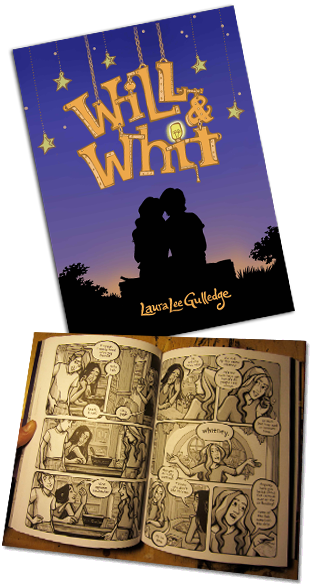
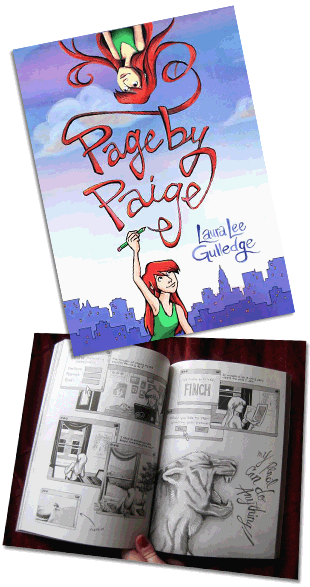
Laura Lee Gulledge came out of nowhere in the comics field, and now has two successful young adult graphic novels out, and is turning one of them into a musical. She's returned to the area after a sojourn in the wilds of New York City and tells us about her methods and her new project, which has ten days left to go on Kickstarter.
We’re holding a Kickstarter right now to help us take our
musical to the next level of development! It ends May 25th so please visit our
site: willandwhit.comDo you have a website or blog?