Eleven Classic Washington Stores DCist Loves
By Sarah Anne Hughes
Oct 16, 2013
http://dcist.com/2013/10/the_11_classic_washington_stores.php
By Sarah Anne Hughes
Oct 16, 2013
http://dcist.com/2013/10/the_11_classic_washington_stores.php

| |||||||||||||||

|
 The documentary then steps back to the 1970s and the lack of trust in government due to Richard Nixon. In this telling, the release of Superman: The Movie in 1978 inspired people, especially with its tagline "You'll believe a man can fly." Several comic book writers point out that Christopher Reeves' great dual performance as Clark Kent and Superman, and the use of romantic situations were the thing that made the movie work more than the special effects. Superman: The Movie also led to a campaign to compensate and credit Siegel and Shuster for their creation, and Kantor covers this in some detail.
 Frank Miller's tour-de force Batman: The Dark Knight Returns (1986) is the next highlight, and is held up as the first adult superhero comic book. Comic book and television writer J. Michael Straczynski called the comic book about an aging Batman "the most seminal work in the field today" and I agree. Mark Waid then notes that 1986 saw another seminal work, Alan Moore and Dave Gibbon's Watchmen. Watchmen took the opposite approach to B:TDKR, and looked at the issues of vigilante justice and fascism inherent in superheroes.
 The film segues into the reworking of Spider-Man by artist Todd McFarlane and the subsequent formation of Image Comics by hotshot young enegade artists. McFarlane's interview segments are among the most entertaining in this segment. The Death of Superman is then examined as another highlight drawing media attention, but also as beginning of the bursting of the collectible bubble as people bought multiple copies as investments.

 Jarringly, Marvel's early 1960s books are discussed before the DC comics that made them possible. Received wisdom is that the Fantastic Four was conceived as a response to DC's success with the Justice League of America. Whether that's true or not, DC certainly reinvented the superhero before Marvel did. Instead the film opens with Marvel, switches back in time to DC and then jumps forward to 1966's camp Batman tv show. Marvel universe co-creators Jack Kirby and Steve Ditko are also given short-shrift.
 Comics slowly-growing social relevance is tracked via the use of an issue of Spider-Man to warn against drugs, even though the Comic Code Authority wouldn't approve it. DC followed that up with an issue of Green Lantern / Green Arrow by Denny O'Neil and Neal Adams that had Arrow's superhero sidekick Speedy as a heroin addict. The section on GL/GA is among the best in this segment, and includes some old film footage of the creators talking about the series at the time. Another good section is Jim Steranko's take on how he reinvigorated Nick Fury, Agent of S.H.I.E.L.D. DC's attempt to depower and do something similar with Wonder Woman is held up as a triumph of feminism, but the comic books sold miserably at the time. Her successful television show (1976-1979), and commentary by Linda Carter round this section out.
 Kantor then moves achronologically again, and switches to a "backlash" against sunny and optimistic superheroes while the real streets of New York are mean and gritty. The death of Spider-Man's girlfriend Gwen Stacy (1973) and the introduction of the Punisher (1974) are held up as examples. The Punisher gets more cultural significance than he deserves - as the film points out, characters such as Dirty Harry had already been successful in movies. Comic books were just following a trend, as usual. The character didn't really take off until the late 1970s when Frank Miller reworked him in Daredevil, and then he truly boomed during the 1980s grim-and-gritty years. Issues from the same year have Spider-Man driving a Spidey-mobile and fighting a hopping villain called the Kangeroo.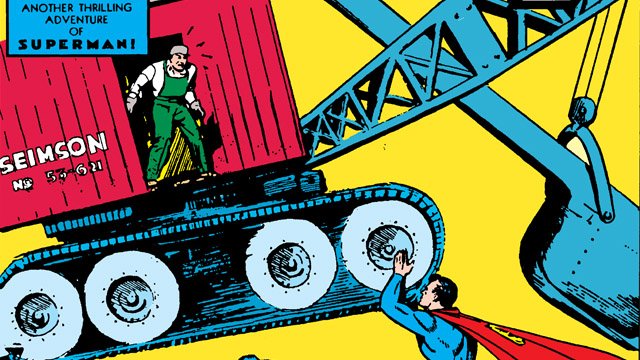
%20DC%20Comics%201946__640x360_q85.jpg?0.7470127153360167)


